
SCUBA Decompression research
SCUBA runs from one no-stop dive on air to a multi-hour ascent held under a decompression ceiling. OpenDeco collects the research, dive-profile data and model implementations across this range.
Recreational and technical diving
Diving stays recreational as long as it stays within the no-stop limits, so no staged decompression stop is needed and a direct ascent to the surface is available at any point. Recreational training typically caps depth at 40 m, on air or nitrox up to 40 per cent oxygen. The usual working limit for inspired oxygen partial pressure is 1.4 bar.
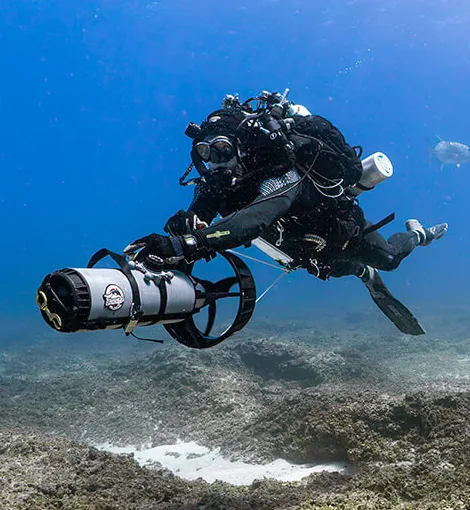
Technical diving accepts a decompression obligation. The ascent is staged, and gas is planned for the whole profile including the stops. Cave or wreck penetration can close the direct route to the surface as well. Helium is one tool within that, used against nitrogen narcosis and work of breathing at depth. Much technical diving uses no helium: air and nitrox decompression dives, extended-range air, wreck and cave work on nitrox.
At the 1.4 bar working limit, nitrox at 40 per cent oxygen reaches its ceiling near 25 m, air near 57 m and trimix at 18 per cent oxygen near 68 m. Oxygen sets a depth limit for a gas. It does not set how long the diver can stay at that depth. The decompression model does that.
Model implementations
Naming the model is not enough to pin down an ascent. The version, the fixed settings and the software build can each change the result, so the record keeps them in separate fields. Two dive computers can both name ZH-L16 and disagree on the same profile. Gradient factors are a pair of settings, a low and a high, that control how conservatively an ascent is run. A schedule that quotes only one of the pair does not fully describe the ascent.
How a model implementation is reconstructedQuestions OpenDeco is investigating
- When two dive computers plan the same dive differently, how much of the difference comes from the model they use, and how much from how each one is set up and built?
- On which kinds of dive do different conservatism settings produce the widest difference, and can that difference be seen in publicly available dive profiles?
- Do deep stops change how inert gas leaves the body enough to affect decompression risk, and on which kinds of dive?
- How well do the experimental profiles behind the published tables represent the dives people record today?
OpenDeco publishes research material. Nothing on this page is a dive plan, a table or operational guidance.
Read the research safety statement